Showing posts with label terai. Show all posts

Sunday, December 5, 2010

Artist Profile: Kamani Devi

Kamani lives with her husband, Raman, two sons and a mother in law. However, her elder son lives four hours away with her sister in a village that has a better education facilities. The only source of income for her family is agriculture.

Years ago, her husband's elder brother, Chumman, was working as an illegal agent for sending laborers for manual jobs to countries such as Iran, Iraq, Dubai, Qatar, South Arabia, etc. Months later, the international immigration laws became highly strict due to September 11 tragic event, making it almost impossible for laborers to travel internationally. Hence, Chumman could not send most of his men to foreign countries though he had already taken huge amount of frees from them. As a result, all those people wanted their money back and Chumman fled from the village, leaving behind Kamani's family to pay back his loans. Hence, they had to sell most of their farmland and it took them years of extreme hard work and saving to recover and reacquire farmland for survival.

Kamani Devi was married at an age of fifteen. Due to early marriage, she bore her first child at an age of sixteen, who was born a sick girl child. It cost Kamani lots of money and resources for the treatment of her daughter but she died at an age of five. After that she gave birth to two more girls and they died as well.

However, she finally gave birth to two sons at later age of about twenty and twenty two. Due to these safer ages of bearing children, both her child were born healthy and she is now happy as a mother of two healthy sons. She is glad to have joined Jurshital Institute, as she hopes to gain some extra money to send her second son to her sister in law's house as well for a better education. She thinks that access to better education to both her sons will result into a better future of her family.


Friday, December 3, 2010

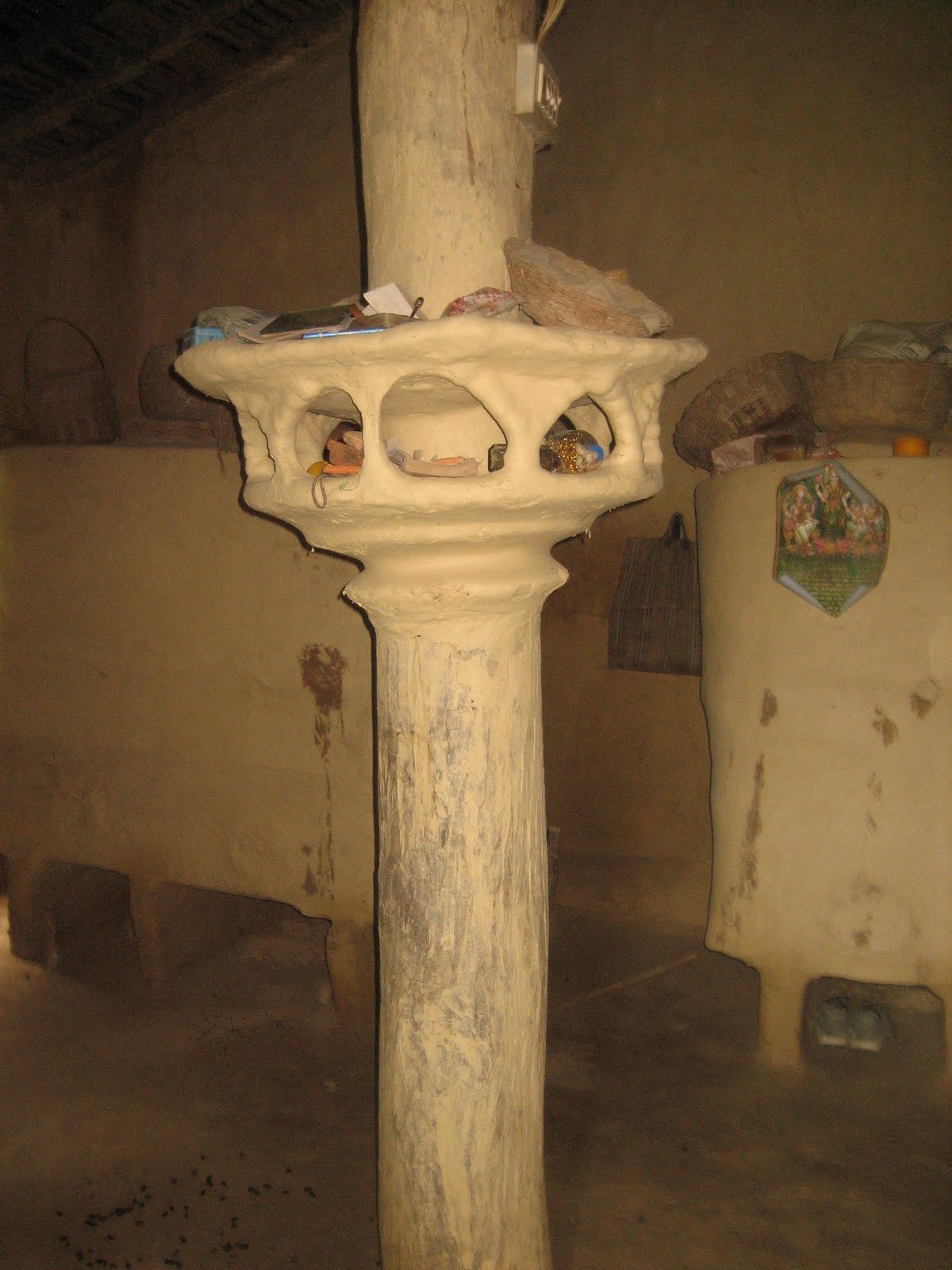
LifeStyle: Storage/Organization


Coming to the second chapter of lifestyle of Mithila Culture, I have put up two pictures. In the picture that is on the right, a mud built rack can been seen. These racks are made by mixing together soil, water, finely cut straw and small percentage of cow dung. They are mixed well and left for couple days so that there is elasticity in the mixed mud. Then the structure is started from the base and up. Meaning, first the base is built, left for couple days (or more depending on the weather) to semi-dry and then more pile of mud is added, adding to the height of the rack. Different shapes are made depending upon the desire and creativity of the Mithila women making them. After the rack is fully dry, it becomes ready for putting things in/on it. The topmost layer is used to keep bigger size objects, for example, the pots in the picture, while the middle/bottom layers are used to store light small objects such as yarn, oil bottle, make up kits, etc.

Similarly, the picture on the left is also made for keeping things in the house organized. This one in particular which is made around a pillar is at an higher reach and hence it is used for things that should be kept away from children, for instance, money, medications, sweets, yogurt, etc. The structure behind the pillar is called Kothi in Maithili language, which is simply a mod build round (sometimes rectangular) box used for storing grains such as lentils, paddy, rice, wheat, etc. All these things are made mostly by women. Men usually do not get involved in any activities that requires dealing with household works. They only work outside of the house.

Wednesday, December 1, 2010

LifeStyle: Cooking

As we are learning more about culture of Mithila paintings, I feel obliged to familiarize you with other cultural aspects of these Mithila families. One of the utmost important part of our lives if food and hence I thought I would bring about the cooking style in this culture.

As seen in the picture, the cooking stoves are usually made from mus that lasts longer and grown stronger with every use. Mithila women, soak a special kind of soil in water for few days before they mix the soil and water well. Then they use this mud to create cooking stoves and paint them with whitish soil again for better outlook.

The stoves have a small mouth through which firewood and other kinds of sources of fire such as those made from cow dung are fed and then lit. The cooking pot is put on top of the mud stove and then the fire is lit, which does the cooking. This traditional kind of cooking method takes longer than the regular electric stoves elsewhere. Also, the firewood produces a lot of smoke. However, once the food is cooked, only ashes are left behind, which is used for cleaning the cooking utensils after meals and/or in the fields for compost.

Sunday, November 28, 2010

Original Mithila Wall Painting

Hi Everyone!

I know I have mentioned that Mithila paintings are originally done on the mud built walls of houses in Mithila region and never really gotten to show what the original wall paintings look like.

The picture on the left is one of the original wall paintings done by a female Mithila student. As you can see, the brick red color is made from red soil, green color from plant leaves, blue color is from the blue ink used in pens, and finally the black color used for the hair is from coal.

The picture is that of Goddess Saraswati, which in Hindu religion is the goddess of Knowledge and Skills such as music and arts. Although she is worshiped by all, students especially worship her for good outcomes in their academics. She is also the wife of Brahma, the God of Creation.

The name Saraswati also has significance in Buddhism. She is known as the guardian deity who upholds the teachings of Gautama Buddha by offering protection and assistance to practitioners.

Thursday, November 18, 2010

The paints bought directly from the market are too thick too be used for the painting. Hence, she is thinning it by mixing the original paint with emulsion, a white colored paint, and water. Recycled tin boxes are used to do the mixing and they are covered after the day's work. The next day, more water is added to the paints as they quicky dry up in hot weather of Halkhori.

Tuesday, November 16, 2010

Two women in this image are cutting the Lokta paper into appropriate size for the Jurshital Institute, where all the women at the Institute will use this paper for Mithila paintings.

Friday, May 28, 2010

Jurshital: a new beginning

Honestly, the idea of starting a blog has crossed my mind several times but I pushed this idea since I identify with lives of most, if not all full time students with a double major (mine being Mathematics and Economics) that go to school every day and strive for the best. But today is a different day and now I have a reason, a new beginning to my life that is going to unfold this summer.

The title of my blog itself, “Jurshital”, a Maithili word, means New Year. I chose this word because my inspiration behind this blog is my project that I am going to do in Halkhori village in Nepal, where I come from. My society back home is dominated by Mithila culture in which we celebrate Jurshital, the New Year during the month of April. Interestingly enough, I was born in April, too! Jurshital is celebrated in Mithila culture by throwing mud at each other, family, friends, etc. Mud carries a special importance in our lives, the Maithili people as more than 90% of us depend on agriculture. As Rakesh writes, “We are born on mud, play on mud and die on mud,” we regard mud as a sacred part of our lives in Mithila culture. No wonder, we Mithila women spend so much time decorating our mud houses with yet other kinds of mud and produce from mud. We decorate our mud built houses by Mithila paintings, passed down from mothers to daughter. We paint the walls of our houses with lively depictions of family celebrations, religious ceremonies or even daily life moments and village scenes. We make the paint from red soil, charcoal, chalk, plant extracts that wash away in the rainy season. This gives us a new start the following year and we repaint the walls every year.

I am taking this Mithila painting to a professional level this summer by training the Mithila women into using the permanent paints, paint brushes so that the paintings are made permanent onto canvas and paper from the temporary ones on the walls. To get a more detailed idea on my project proposal, please refer to my next blog. And wish me a very best for the new beginning to my life. Happy Jurshital!